Showing posts with label fynbos. Show all posts

13 December 2011

Sunshine flowers


Aren't these just yum? It's a hybrid of Leucadendron called 'Summer Sun'. I had ordered a wide variety of fynbos for a farm landscape outside Caledon (Western Cape), and of all the plants standing in my driveway, this one was my favourite.


The pompons which look like flowers are in fact cones - male cones to be exact. The genus Leucadendron (collectively known as Conebushes or tolbos in Afrikaans) is dioecious - in other words male and female flowers are borne on separate plants. The flowers are clustered together in 'cones' and are pollinated either by wind or insects, depending on the species. The pale coloured 'petals' are in fact involucral bracts. That's the science - and then there is the beauty...


Summer Sun is a hybrid between Leucadendron laureolum and a Peninsula endemic, L.strobilinum. They are adapted to winter rainfall and nutrient poor soils. If you live in SA and just have to have Summer Sun in your garden, you can get plants from Arnelia. Remember they require well-drained acidic soil. You can compost / mulch the plants, but no phosphorous, and remember it's best to plant in autumn or winter.

18 October 2011

The Fan Aloe


This magnificent Fan Aloe (Aloe plicatelis) is flowering in a garden in Muizenberg. Although it is a true fynbos species - occurring only on Table Mountain sandstone soils, in fynbos areas - it is not native to the Cape Peninsula. Which means this one was planted.

I wonder who planted it, and when?
Judging by the size (height: 2.5m), thick woody trunk and slow growth rate of this species, my guess is that it could be 50 to 70 years old. A real grande dame...

24 September 2011

Homegrown

This year I have my first show of Leucospermum 'Spider' in my garden. It's a hybrid of Leucospermum tottum with typical grey-green leaves and salmon-pink flowers.


I think the flowers are breath-taking - can't get enough of them!

23 March 2011

Biodiversity Garden Update

t
What's happening in the Biodiversity Garden these days? It's the end of summer, so not many local Cape species are in flower. But fynbos is all about foliage textures, so there is plenty to enjoy.

In the photo above there is Leucadendron 'Blush' - a selection of Leucadendron salignum with gorgeous wine-red involucral bracts - shown off against fine-leaved grey Slangbos (Stoebe plumosa) growing behind.

Wild Dagga (Leonotis leonurus) is in full flower in the Medicinal Plants display. Much to my delight we spotted a sunbird visiting the flowers last week, feasting on nectar.

Blombos (Metalasia muricata) is a wonderful texture plant - seen here in the Coastal thicket. The beaded creatures have taken on a slighty faded hue, and are now lurking among plants, instead of a stark new landscape...


In the Amazing Cape display we have an exciting addition: Aloe commixta, a rambling aloe which is endemic to the Cape Peninsula (bottom left, above). A member of the public kindly offered these plants from his garden. The story of this aloe gift and their planting has been documented by SABC Greenline, so look out for it on tv.

The Khoikhoi huts are looking more natural, surrounded by soft grasses and renosterveld. Below: Hyparrhenia hirta (left), Cymbopogon (? middle) and Eragrostis curvula (right)


In the water Bolboschoenus maritimus is in flower. I like it - one of my favourites.


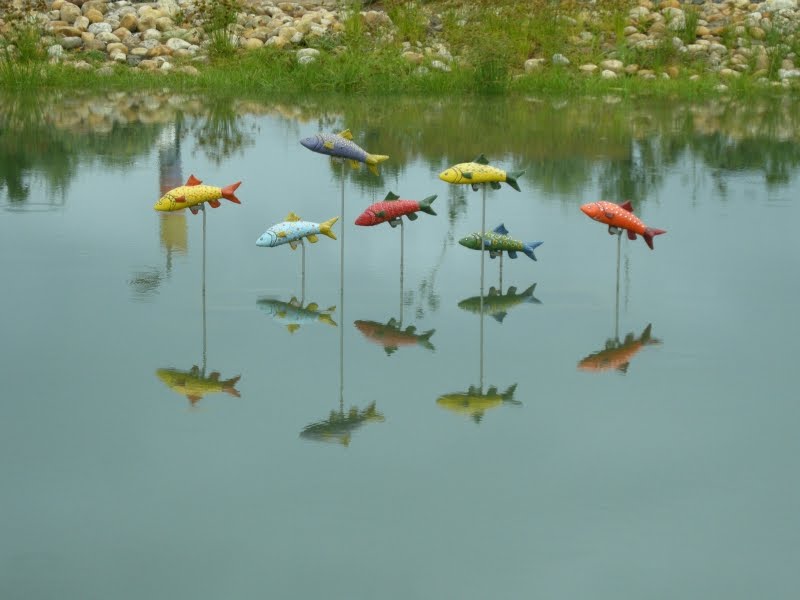
The lake level is high - at its maximum - and the school of fish are happily frolicking in the water. Hopefully they will receive company some time soon: the Park Manager is busy organising the introduction of local Cape fish (Galaxia sp) - which involves Cape Nature, breeding permits etc. So please DON'T introduce any alien fish - rather wait for the locals!

14 March 2011

Up & Down Table Mountain

On Sunday a friend and I went up Table Mountain, while over 32 000 cyclists were making their way around the Peninsula on the Argus cycle tour. Luckily the road closures still permitted us to get to Camps Bay, the start of our walk.

The weather was perfect: wind still and cool. We walked up in the shade of Kasteelpoort, stopping a few times to catch our breath and take in the views. Once at the top, we went to the Valley of Isolation, which offers great views south down the length of the Peninsula. Below one can see the end of the Woodhead Dam, and Grootkop on the right.


After an early lunch on some comfy restios we climbed out of the Valley of Isolation, and turned left (west) on a little-used track going down Ark Valley. We were using Mike Lundy's walking guide, but missed an even less-used turnoff, so ended up right on the edge of the escarpment. Just then the clouds set in, swirling around us, offering partial glimpses of the world below.


Yikes - there were steep butresses and precipitous cliffs everywhere - were we really meant to go down here?


We decided to play if safe and went back to the route description and found a path which took us back to the Valley of the Red Gods. Along the way, in a damp kloof we came across this little cluster of blue disas.

Disa graminifolia


And then we started a spectacular descent known as Diagonal Route. The path starts at Barrier ravine, crosses Jubilee ravine and after a short traverse one dips into Porcupine ravine. It offers breath-taking views, but is quite exposed in places - not for those with a fear of heights.

And then the real downhill started: a steep descent on rock which looked like it would be a little stream in winter. Mike suggested that 'when one runs out of terra firma (in the ravine) one should look out for a path along a bushy ledge' - and we did just that, which took us around Porcupine buttress and back down to the Pipe Track.

Thanks Jana - that was a great walk.

04 March 2011

Walk above Llandudno

Thursday afternoon we went for a sunset walk from Suikerbossie up Hout Bay corner to Llandudno Ravine. The views are spectacular - first over the Houtbay valley:


And once you've ascended Hout Bay corner, views over Little Lions Head and Llandudno. There are a few places where one has to scramble or climb - with the aid of stainless steel handles - so the Mickey dog needed some help.


Much to our surprise we came across a Himalayan Tar - obviously one which the rangers missed out during the relocation programme a few years ago. It was a male, and totally unafraid of our presence. Min gepla. I didn't know whether to look at the tar or the bird of prey sitting on the rock above!


I noticed the tar browsed a few leaves of the Wild Camphor, Tarconanthus camphoratus. So much for the plant producing aromatics and secondary compounds as a defence against animals!


Once we rounded the corner we were on the exposed west side. I noticed a distinct increase in succulents (Cotyledon, mesembs and Tylecodon grandiflora, in flower) and some shrubs, notably Coleonema, were looking stressed, with yellow leaves, all rolled up. March is a tough month for fynbos.


I made a bee-line for the shade in Lekkerwater Gulley, where we enjoyed a sunset drink of water and some fruit. I'd love to go back and continue to Judas Peak next time, returning via Myburgh Ravine.

Looking back along Eureka Face towards Karbonkelberg and beyond.


Looking in the other direction, towards Oudekraal are steep slopes clothed in fynbos, as far as the eye can see, with a totally unspoilt coastline. It is wild and inaccessible - untamed Nature.

Peter Slingsby, who has created such an informative map series of the Peninsula, writes:
These very very empty slopes - perhaps the least frequented parts of the whole of the Cape Peninsula - are mostly private property and not conserved as part of the National Park.

May we hope that this truly untracked wilderness within the City boundary remains forever for future generations as a tiny glimpse of this whole Peninsula as it was before 1652.

I feel incredibly fortunate to live in a City with such natural beauty and biodiversity - right on our doorstep.

11 February 2011

A walk up Cecilia Ridge

A few weeks ago I felt like a long view and some solitude, so I parked at Cecilia Forest and headed up Cecilia Ridge. It's an easy way up the montain with lovely views over the City.


Crassula coccinea - Klipblom

Protea speciosa - since I saw it at Silvermine for the first time, I'm seeing it everywhere. Funny that. The white hairs on the leaf margins seem distinctive.


And then I made a short detour to the De Villiers dam, which is looking rather surreal in its half-empty state. Ghostly white sandstone rocks.

The water is a beautiful tea colour, on account of the phenols and tannins found in fynbos. These chemicals leach out of decomposing plant matter in seeps and streams, giving the water its characteristic brown colour. Having grown up in the Cape, I will always associate pristine mountain streams with brown water.


Then Mickey and I headed down the mountain, on the jeep track.


These miserable Knysna Yellowwood trees were planted decades ago - presumably by foresters. Podocarpus falcatus is not local to our area and is locally invasive in the lower forest, growing like hairs on a dog's back. They are displacing local forest species, including our local yellowwood, Podocarpus latifolius.

I find it extremely irritating and embarrassing that Table Mountain National Park does nothing about their removal, not to mention the thousands of other invasive aliens - and this is supposed to be a World Heritage Site!


I like pine forests because they are incredibly silent - the needles absorb any sound underfoot and they are almost devoid of wildlife, except for the odd bird of prey. All the forests on Table Mnt are being systematically felled - soon there will be none left.

I am a great biodiversity fan and support the removal of aliens (including pines) on high mountain slopes. But to remove every single tree and bit of shade on the urban edge, in areas which are highly transformed and have little conservation value anyway - in the name of CONSERVATION - is ridiculous.

There has been a huge public outcry in Cape Town about the wholesale removal of these forests in recreational areas - to absolutely no avail. The managers at Table Mnt NP reign supreme. Unfortunately this kind of hard-core fanaticism does not win support for Cape biodiversity - on the contrary, it alienates people.


So better enjoy the forests while they last!

05 February 2011

Orange Kloof Walk

I am very lucky to have a friend who has a research permit for Orange Kloof which means we can walk there without an guide. Saturday morning we set off, up Constantia Corner which offers lovely views over Hout Bay and Orange Kloof (on the right of the pic).


I've been up Constantia Corner many times, and we did the same walk a year ago, so the plant populations en route are familiar to me - it felt like I was checking up on old friends.


My favourite part is right on top of the mountain, with grassy-restiod fynbos and those sculptural sandstone rocks - and no sign of the City or human habitation. We had coffee and croissants at the rock shelter.


Then past Camel Rock and the Overseer's hut (now some kind of Hoerikwagga lodge, complete with surburban latte fence) and over the Hely Hutchinson dam wall...


Finally we dropped down into Disa Gorge into the resticted Orange Kloof. The wall is made of the local grey sandstone which has been beautifully hewn into massive rectangular blocks. I admit I have a penchant for bold feats of engineering like bridges, dams and stone aqueducts in wild landscapes. They have a scale and sculptural quality which appeals to my senses.


Not the same dam wall, but another one close by, showing the quality of the stone work (March, 2010).


The path drops into a forested kloof, and for a little while the vegetation is lush and the extra moisture is tangible. Here is Marie, on our walk a year ago.

This time Mike and I stopped for a few flowering disas, but my eye was irresistably drawn to the pretty new foliage of Blechnum.


Red Disa, Disa uniflora

Why do we always take pictures of the perfect flower? Here is the one next door: it think it's pollinia were eaten - noshed by a hungry beetle rather than removed by its delicate pollinator, the Mountain Pride butterfly.


Along the way Mike kept a count of Mountain Pride butterflies - he had eight sightings in all. Meneris tulbaghia is the sole pollinator of a guild of orange and red flowered fynbos species which flower between November and March. The butterfly is unusual in that it one of few insects that can see red in the visible spectrum - and is therefore the sole insect pollinator of these red-flowered plant species. I have seen it swoop down on a red backpack or hiker's socks, and even a red Opel Kadett!

Along our path and on the butterfly's menu, so to speak, were: Crassula coccinea, Red Disa (Disa uniflora) and Tritoniopsis triticea.

Crassula coccinea, Klipblom

Although we didn't see the Cluster Disa (Disa ferruginea), this species is also visited by the Mountain Pride Butterfly. It is interesting that the disa doesn't offer a nectar reward and mimics Tritoniopsis, a nectar-producing irid. When the butterfly visits the Cluster disa, and sticks its proboscis down the floral tube in search of nectar, there's nada! nothing there - but the disa deposits its sack of pollen (pollinia) on the butterfly. It's trickery and deceit in action.

Further along the way there is a nice stand of Leucadendron strobilinum - another endemic to Table Mountain. Fynbos is characterised by its high degree of endemism, so this is not unusual - in fact I can be a bit blase about it. But actually it is remarkable that this species is found only on this mountain and nowhere else in the world. Thank god it is fairly well-protected in the Table Mountain NP (if they finally get round to urgent alien clearing and erosion control in the Park).


Leucadendron strobilinum is easy to recognise by the fringe of silky white haris on the leaf margins.

Along the way we came across this chap - no idea what he's called. Methinks I need to acquire a reptile book...