Showing posts with label Green Point Park. Show all posts

17 September 2013

The Biodiversity Showcase Garden revisited

Spring has sprung in the Biodiversity Garden at Green Point Park. Parts of the garden are awash with colour, such as the 'Hybrids and cultivars' display seen below.


I like the way the 'Invasive plants' display has turned out, with the rare and endangered Strawberry Spiderhead crowded out by statuesque invasives.


This is what the same planting looked like in December 2010. Notice how the coastal thicket in the background has effectively screened the lawn display - the thicket is now about 2m high.


The 'Shade Dome' is still looking stark and err... where is the shade? The fast-growing Forest Pea (Dipogon lignosus) which raced to the top and looked so promising last year, is now bare at the base, and looking untidy with a lot of dead material on the frame. The Wild Grape (Rhoicissus digitata) is the trust-worthy long-term solution, but growing very slowly. Too much competition, perhaps. I've asked the area around the base of the climbers to be cleared.


The Hedge display is looking good enough. The Confetti Bush (Coleonema album) and Grewia robusta are thriving, but unfortunately it's too wet for the grey Beach Sage (Salvia africana-lutea) which has died back in places. We will replace it with Rhus glauca (Blue Kuni-bush) which also has greyish leaves. 

One of the challenges of gardening in the Biodiversity Garden is the heavy clay soil and high water table. In fact the Green Point Park area used to be a seasonal wetland, and sailing regattas were held here! Clay soil dredged from the harbour (now the V&A Waterfront) was brought in to create sportfields and recreational amenities in the 1900s.


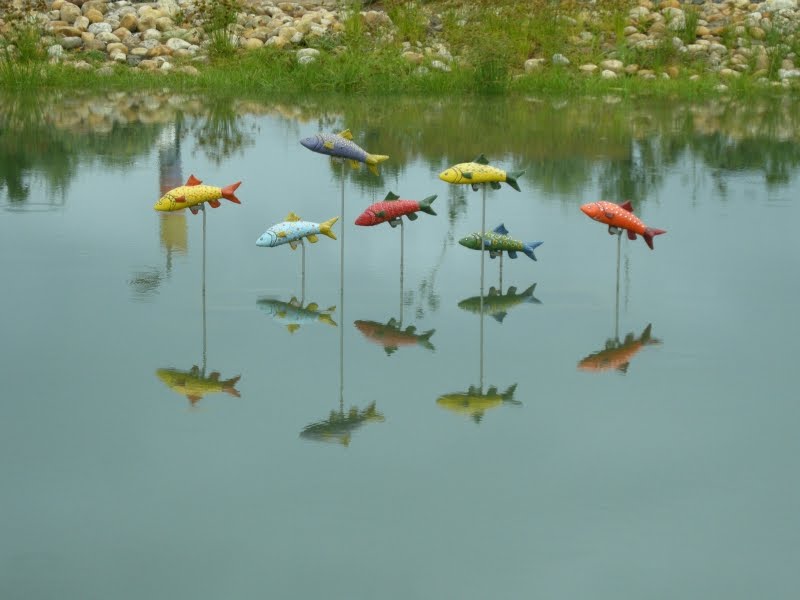
A life ring has been installed right in the framed view of the fish - what a pity. I understand safety comes first but aesthetically it's plain awful.


The frolicking fish don't mind at all...


24 September 2011

Winter Colour

Busy times! - months have passed since I have given an update on the Biodiversity Garden. Here are some pics taken in July:

The Mountain Aloe (Aloe arborescens) is in full swing.


Bright red torches of Aloe succotrina in the Mountain Fynbos section. This aloe species is a fynbos endemic - usually found in rocky areas or scree slopes.


Daisies such as Arctotis and Osteospermum are in full bloom.


Jordaniella dubia in the Strandveld section.


Lachenalia reflexa in the Lowland Fynbos section. I was surprised to see this diminuitive plant on the Alert List for Environmental Weeds in Australia. "Yellow Soldier was first recorded as naturalised south of Perth, Western Australia, in 1957, probably after escaping from a garden planting. It has since become a problem weed and is spreading through tuart (Eucalyptus gomphocephala) and banksia woodlands".


Plakkie or Pig's Ears (Cotyledon orbiculata) are flowering now.

The newly planted Coleonema album hedge in the Hedging display area.

Restios, grasses and aloes in the Mountain Fynbos display.

29 May 2011

Something new in Green Point Park

ttt
What's this, lurking behind the bushes?

There's something new behind the grysbokkie...


Aha! - it's the new water wheel. It will be set into motion by spring water, which has been piped from natural springs in Oranjezicht to the Green Point Park. I am told the flow rate of the Camissa spring water is 4o liters per second - that's 2400 liters per minute! (actually that sounds too much - need to check this info). Anyway, energy generated by the water wheel will be used to power street lighting in the Park. Very neat.

And another beautiful wintry evening scene...


13 May 2011

Biodiversity Garden - Visitors and Evaluation

Is the interpretive signage in the Biodiversity Garden effective?
It is not an easy thing to evaluate, but I would say people are reading them. However the degree of interpretation part is harder to evaluate. A few storyboards in the Garden engage the reader directly - e.g. Look up to Signal hill - and so when you see someone looking up at the hill, then it's working.

I noticed these two ladies read almost every single sign in the People and Plants theme area, and looked pretty absorbed. The lady in black was leaning forward - means the text is a bit too small.

I just missed the moment: when this lady bent down to pick and smell a piece of wild rosemary - as invited by the storyboard: Reach out to the wild rosemary bush in front of you. Squeeze some leaves gently and smell your fingers. Would you cook with this herb?
John Roff was instrumental in co-writing the texts and finding opportunities to engage visitors. I find this kind of interpretation in action rewarding and exciting!


A cold misty morning (13 degrees) and yet there was a group of school kids in the garden.

Here Wendy Hitchcock is with a school group on another cold morning - playing a climate change game. I heard a roar of excitement and later I heard from Wendy that they were cheering for the roll of the dice which would create a mass extinction!


The visitor's book is almost full. Many comments refer to people feeling proud of our City and what it has achieved (in the Park). There are hundreds of thank yous - a wonderful sense of gratitude.

And then there are the visitors of a different kind: a bee collecting pollen from the sour fig, Carpobrotus acinaciformis. Plus 2 other insects.

I was wondering why some climbers on the Dome had no leaves? One of the Kirstebosch guides pointed out this fat fellow - about 10cm long and as thick as a fat cigar. I wonder what moth or butterfly it will turn into?

Visitors from the Stellenbosch municipality testing the Exercise equipment. And a small sample of folk going through the Biodiversity Garden last Friday, 19th May:


On misty mornings the Garden is bejewelled with spider webs...it's magical.


Our goal is that people leave the Biodiversity Garden with an understanding of biodiversity and why we need it; a love for our natural heritage and the desire to care for it for future generations.

Are we achieving this goal? How does one measure whether it's working?
Although we've had a positive response from the public (in the visitor comments book, on radio phone-ins, emails, during guided walks) it remains a tricky thing to measure. How does one evaluate 'love' and a desire to care?

And the 'understanding of biodiversity' - how does one test someone's knowledge without putting them on the spot?

I would welcome any ideas you may have.

07 April 2011

Sunday - Concert in the Park

t
On Sunday, 3rd April the City hosted its first concert in the Green Point Park. Stephen Granger attended the event with his photographer's eye and long lens. Judging by the pics, there were many people enjoying themselves, and the event was a great success.


Thanks Stephen for sharing your photos.

23 March 2011

Biodiversity Garden Update

t
What's happening in the Biodiversity Garden these days? It's the end of summer, so not many local Cape species are in flower. But fynbos is all about foliage textures, so there is plenty to enjoy.

In the photo above there is Leucadendron 'Blush' - a selection of Leucadendron salignum with gorgeous wine-red involucral bracts - shown off against fine-leaved grey Slangbos (Stoebe plumosa) growing behind.

Wild Dagga (Leonotis leonurus) is in full flower in the Medicinal Plants display. Much to my delight we spotted a sunbird visiting the flowers last week, feasting on nectar.

Blombos (Metalasia muricata) is a wonderful texture plant - seen here in the Coastal thicket. The beaded creatures have taken on a slighty faded hue, and are now lurking among plants, instead of a stark new landscape...


In the Amazing Cape display we have an exciting addition: Aloe commixta, a rambling aloe which is endemic to the Cape Peninsula (bottom left, above). A member of the public kindly offered these plants from his garden. The story of this aloe gift and their planting has been documented by SABC Greenline, so look out for it on tv.

The Khoikhoi huts are looking more natural, surrounded by soft grasses and renosterveld. Below: Hyparrhenia hirta (left), Cymbopogon (? middle) and Eragrostis curvula (right)


In the water Bolboschoenus maritimus is in flower. I like it - one of my favourites.


The lake level is high - at its maximum - and the school of fish are happily frolicking in the water. Hopefully they will receive company some time soon: the Park Manager is busy organising the introduction of local Cape fish (Galaxia sp) - which involves Cape Nature, breeding permits etc. So please DON'T introduce any alien fish - rather wait for the locals!