Showing posts with label My garden. Show all posts
24 September 2011
Homegrown
This year I have my first show of Leucospermum 'Spider' in my garden. It's a hybrid of Leucospermum tottum with typical grey-green leaves and salmon-pink flowers.
25 February 2011
Tomato take-over
t
Vegetables on a biodiversity blog?
I'm really sorry - just wanted to show how many tomatoes came out of my veggie garden last week. Enough to give to several neighbours and make a big pot of sauce, and still wonder what to do with the rest.

Riccardo gave me a few seedlings of this Italian tomato. Sliced open with S&P, some basil and a drizzle of olive oil... they are delicious!
When I threw a few ripes ones into a pot of Roma tomatoes, the difference became clear: the flesh of Riccardo's tomato is firm and a dark, almost wine-red colour, and the pips aren't so juicy. I'm sure they would make a superior sauce.
Vegetables on a biodiversity blog?
I'm really sorry - just wanted to show how many tomatoes came out of my veggie garden last week. Enough to give to several neighbours and make a big pot of sauce, and still wonder what to do with the rest.
Riccardo gave me a few seedlings of this Italian tomato. Sliced open with S&P, some basil and a drizzle of olive oil... they are delicious!
When I threw a few ripes ones into a pot of Roma tomatoes, the difference became clear: the flesh of Riccardo's tomato is firm and a dark, almost wine-red colour, and the pips aren't so juicy. I'm sure they would make a superior sauce.
14 February 2011
In the garden
My garden is blessed with many chameleons - probably due to the absence of cats and pesticides. I am absolutely fascinated by these creatures - when I see one, I just have to take a pic.
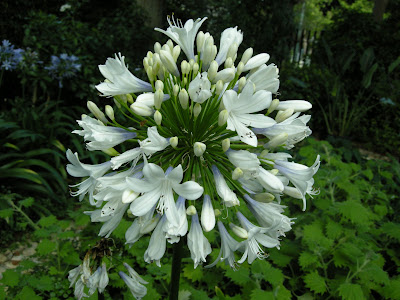
I'm not the best chameleon spotter: I usually see them just as I'm about to prune or chop something down! - in this case agapanthus. Needless to say I put my secateurs away, and grabbed my camera instead.


I'm not the best chameleon spotter: I usually see them just as I'm about to prune or chop something down! - in this case agapanthus. Needless to say I put my secateurs away, and grabbed my camera instead.
The Cape Dwarf chameleon gives birth to live young and I do sometimes see a bunch of litte ones all on one bush. Technically they are ovoviviparous - i.e. they produce eggs but retain them inside the female body until hatching occurs. According to Vincent Wagner (The Life of the Chameleon, 1983):
Each baby is extruded separately, the process taking 5 to 20 seconds, in a fairly tight-fitting membranous bag, with its tail wrapped around itself...The parent prefers to be on a horizontal or sloping, fairly thick branch, so that the bag is deposited on it. With a few convulsive wriggles the young chameleon immediately breaks the bag and climbs out... At 2 to 5 min intervals the female produces the rest of the family, and then unconcernedly walks off, and forgets all about them. The baby has a body 12mm long and a tail 18mm long.
Now that is something to look out for!
The number of young produced varies, but is often around a dozen. There appears to be no fixed season for birth, and there may be more than one litter per year.
The Common Chameleon (found in the northern parts of SA) lays her eggs in soil - usually about 4 times as many as the Dwarf Chameleon. They are laid in March and take 10 months to mature.
Fascinating - these different reproductive strategies.
Each baby is extruded separately, the process taking 5 to 20 seconds, in a fairly tight-fitting membranous bag, with its tail wrapped around itself...The parent prefers to be on a horizontal or sloping, fairly thick branch, so that the bag is deposited on it. With a few convulsive wriggles the young chameleon immediately breaks the bag and climbs out... At 2 to 5 min intervals the female produces the rest of the family, and then unconcernedly walks off, and forgets all about them. The baby has a body 12mm long and a tail 18mm long.
Now that is something to look out for!
The number of young produced varies, but is often around a dozen. There appears to be no fixed season for birth, and there may be more than one litter per year.
The Common Chameleon (found in the northern parts of SA) lays her eggs in soil - usually about 4 times as many as the Dwarf Chameleon. They are laid in March and take 10 months to mature.
Fascinating - these different reproductive strategies.
05 February 2011
Summer in the garden
Happy summer days in my garden, despite the heat and unusual humidity. The plants thriving under these conditions and blooming now are those which have their origin in the summer rainfall region of our country.

Among the stepping stones I come across a lovely surprise: I noticed Boophane distacha, the Bushman Poison Bulb, making its first bud. It's that small pink dot on the righthand side of the pic.
Boophane - known as Gifbol in Afrikaans - contains extremely toxic alkaloids which can be fatal when engested. Notwithstanding it is used medicinally: the dry outer scales are used as a dressing after circumcision and weak decoctions of the bulb scales are used as an enema to treat various complaints, or as a sedative. Higher doses lead to hallucinations and even higher doses can be fatal. Boophane disticha was used by the Khoisan to get into a trance state, and it is one of only two plant species depicted in rock paintings. The fan of pleated leaves is very distinctive - even on the painting.

Around the corner, under the oaks, the shade garden is looking lush and green.


This part of the garden was planned as a White Garden, and indeed there are white flowered species such as Pavetta, Rothmannia, Japanese Anemone and white azaleas - but there are as many blue and mauve exceptions. Guess I'm not very good at sticking to rules!

Crinum moorei - at this time of the year the leaves are in tatters, but the tall blooms make up for it. The fresh green upright foliage is a real asset in the winter garden.


In the bathroom garden, it is the time of Scadoxus multiflorus ssp. katherinae. In the first year that I planted it, there were no flowers, and since then there as been one more flower each year. So in Scadoxus Time I have lived here for 5 years.


Among the stepping stones I come across a lovely surprise: I noticed Boophane distacha, the Bushman Poison Bulb, making its first bud. It's that small pink dot on the righthand side of the pic.
Boophane - known as Gifbol in Afrikaans - contains extremely toxic alkaloids which can be fatal when engested. Notwithstanding it is used medicinally: the dry outer scales are used as a dressing after circumcision and weak decoctions of the bulb scales are used as an enema to treat various complaints, or as a sedative. Higher doses lead to hallucinations and even higher doses can be fatal. Boophane disticha was used by the Khoisan to get into a trance state, and it is one of only two plant species depicted in rock paintings. The fan of pleated leaves is very distinctive - even on the painting.

Around the corner, under the oaks, the shade garden is looking lush and green.


This part of the garden was planned as a White Garden, and indeed there are white flowered species such as Pavetta, Rothmannia, Japanese Anemone and white azaleas - but there are as many blue and mauve exceptions. Guess I'm not very good at sticking to rules!

Crinum moorei - at this time of the year the leaves are in tatters, but the tall blooms make up for it. The fresh green upright foliage is a real asset in the winter garden.


In the bathroom garden, it is the time of Scadoxus multiflorus ssp. katherinae. In the first year that I planted it, there were no flowers, and since then there as been one more flower each year. So in Scadoxus Time I have lived here for 5 years.

19 January 2011
Fynbos in the suburbs
t
My garden in May last year. In the foreground: an Erica hybrid with salmony pink flowers and Leucadendron 'Blush'.
I have about 4 m2 which receives enough sun for growing proper fynbos - the space is more precious than real estate. At present there are a few Agathosma, Phylica ericoides, Scabiosa incisa, grasses, Cotyledon orbiculata, Gazanias, Geranium incanum and the red leucadendrons. We won't talk about turnover - that would be telling.
My garden in May last year. In the foreground: an Erica hybrid with salmony pink flowers and Leucadendron 'Blush'.
I have about 4 m2 which receives enough sun for growing proper fynbos - the space is more precious than real estate. At present there are a few Agathosma, Phylica ericoides, Scabiosa incisa, grasses, Cotyledon orbiculata, Gazanias, Geranium incanum and the red leucadendrons. We won't talk about turnover - that would be telling.
06 January 2011
Subscribe to:
Posts (Atom)
.jpg)
.jpg)
.jpg)


